


What Are Real World Assets (RWA)?
Real World Assets (RWA) are digital tokens on a blockchain that represent ownership of tangible physical assets or traditional financial instruments, such as real estate, government bonds, or gold. By "on-chaining" these assets, tokenization allows for 24/7 trading, fractional ownership, and instant settlement within the DeFi ecosystem.
- Market Dominance: As of Q1 2026, the combined RWA market now exceeds $320 billion, primarily driven by fiat-backed stablecoins. Tokenized RWAs are now 6.4% the size of stablecoins, up from 2.7% in 2025.
- Institutional Integration: Massive growth in tokenized treasuries (e.g., BlackRock's BUIDL) has bridged the gap between TradFi and crypto.
- Key Benefits: RWA protocols unlock "real" yield for DeFi users and provide fractional access to high-value assets like commercial real estate.
The RWA Landscape at a Glance (Q1 2026)
The RWA market is highly diversified. Below is the breakdown of the major sub-sectors based on CryptoSync's RWA Report 2026.
- Total Market Value: Exceeds $320 billion.
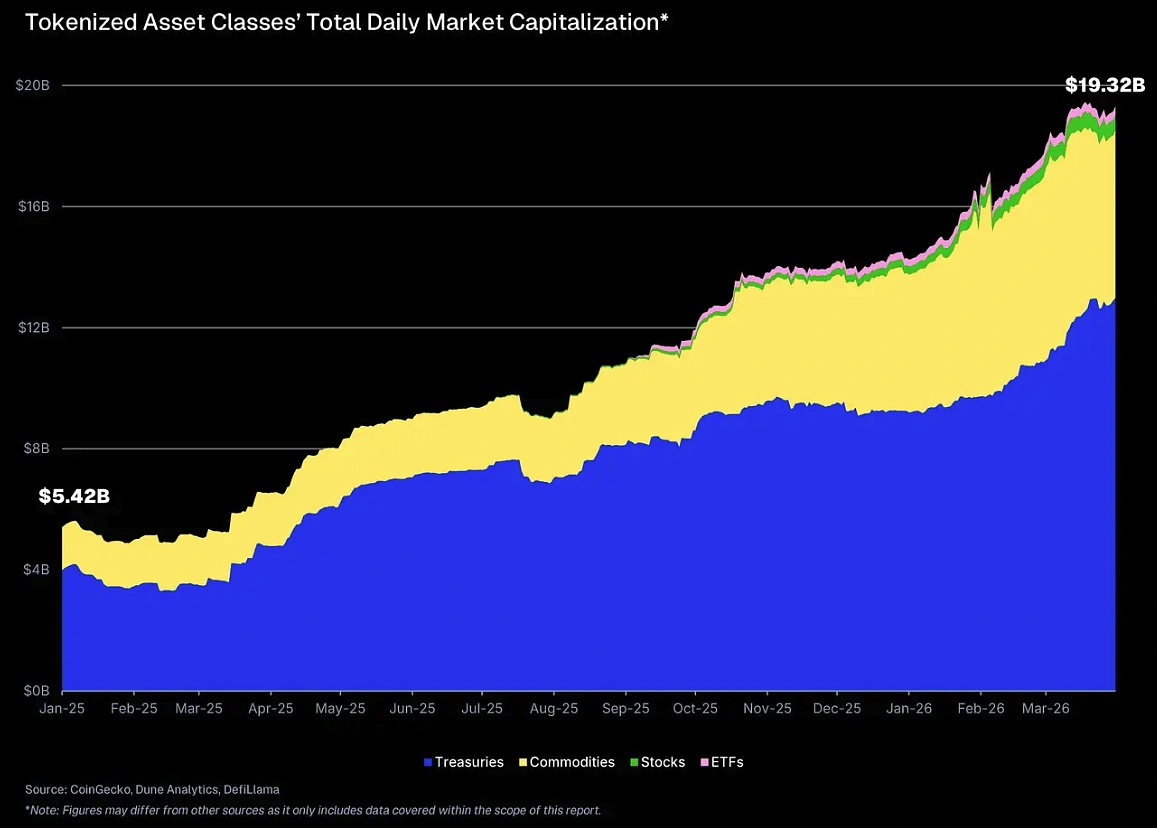
- Growth Rate: Tokenized RWAs (excluding stablecoins) grew 256.7% over fifteen months, from $5.42 billion in January 2025 to $19.32 billion by March 31, 2026.
- Fiat-Backed Stablecoins: This sub-sector dominates the market with a valuation of $301.65 billion, a 51.0% increase since January 2025.
- Tokenized Treasuries: A rapidly expanding segment valued at $12.99 billion, having tripled since the start of 2025.
| RWA Category | Market Value (2026) | Leading Project/Asset | Primary Driver |
| Fiat Stablecoins | $301.65 Billion | USDT ($184.1B) / USDC ($77.4B) | On-chain Liquidity |
| Tokenized Treasuries | $12.99 Billion | Circle USYC ($2.69B) / BlackRock BUIDL ($2.17B) | Institutional Yield |
| Commodity Tokens | $5.55 Billion | Tether Gold XAUT ($2.52B) / PAX Gold PAXG ($2.32B) | Gold Price Rally |
| Private Credit | $2.29 Billion | Maple Finance ($2.13B active loans) | Institutional Crypto Lending |
| Tokenized Stocks | $486.69 Million | Circle, Tesla, Nvidia | Regulatory Clarity |
| Tokenized ETFs | $297.50 Million | Ondo SPDR S&P 500, iShares Silver Trust | On-chain TradFi Access |

The RWA sector has evolved from a niche experiment into one of the most credible and capitalized sectors in crypto. Based on data from CryptoSync's RWA 2026 Report, the size of the RWA market is over $320 billion.
All data points in this article are taken from CryptoSync’s RWA 2026 Report.
The bulk of this value comes from stablecoins ($301.65 billion), with other key categories including tokenized treasuries ($12.99 billion), commodity-backed tokens ($5.55 billion), tokenized stocks ($486.69 million) and private credit ($2.29 billion).
Data from CryptoSync tracking the total tokenized RWAs' market capitalization over the 15 months spanning January 2025 to March 2026 shows a 256.7% growth between January 2025 ($5.42 billion) to March 2026 ($19.32 billion).
How Does Tokenization Work?
Tokenization is the process of converting ownership rights of a real-world asset into a digital token on a blockchain. While technical details vary, the process generally involves three key stages:
-
Off-Chain Structuring: To legally prepare an asset, it is first isolated within a protective legal wrapper, like a Special Purpose Vehicle (SPV). It is then overseen by a Regulated Asset Manager for compliant management and a Licensed Custodian who securely safeguards the off-chain collateral.
-
Data and Valuation: Information about the asset, including its value and legal title, is verified. This data is crucial for establishing the digital token's value and legitimacy.
-
On-Chain Token Issuance: A smart contract is used to "mint" (create) digital tokens on a blockchain, with each token representing a share or a direct claim on the underlying asset.
Economic Utility and Democratization
Tokenization alters traditional investment structures by introducing new functionalities:
- Yield Generation: Investors gain access to yield-bearing traditional assets through decentralized finance (DeFi) interfaces.
- Fractional Ownership: High-value assets, such as commercial real estate, can be split into smaller denominations, lowering minimum investment thresholds.
- Global Accessibility: Blockchain infrastructure removes geographic barriers, allowing cross-border investment in previously exclusive markets.
Tokenizing a U.S. Treasury Bond
The market for tokenized treasuries has continued its explosive growth, tripling from $4.00 billion at the start of 2025 to $12.99 billion as of March 31, 2026 — a 225.5% increase. Here is how the tokenization process works:
-
Structuring: BlackRock, as the Regulated Asset Manager, purchases U.S. Treasury securities and places them into a dedicated fund (the legal wrapper). A custodian like BNY Mellon physically safeguards these bonds.
-
Issuance: BlackRock issues the BUIDL digital token, which represents a share in the fund and is backed by the real-world treasury bonds.
-
Yield Distribution: As the underlying bonds generate yield, that value is passed on to BUIDL token holders.
This process transforms a traditional financial instrument into a programmable and globally accessible digital asset. BUIDL's trajectory illustrates the appetite for this: it briefly captured nearly half the tokenized treasury market before settling at a 16.7% share as competition intensified — a sign of a maturing market that now counts four products above $1 billion in market cap, up from just one a year earlier.
Types of Real World Assets
The RWA ecosystem is diverse, but most of the value is concentrated in a few key categories.
Fiat-Backed Stablecoins
Fiat-backed stablecoins are digital tokens pegged 1:1 to a real-world fiat currency, like the U.S. Dollar. They are a fundamental type of RWA because each on-chain token is directly backed by reserves held off-chain. To maintain this peg, issuers hold reserves of equal or greater value. The composition of these reserves varies; Circle (USDC) primarily uses cash and U.S. treasury bills, while Tether (USDT) also includes corporate bonds and even Bitcoin.
This is the most dominant RWA sector, with a market capitalization of $301.65 billion as of March 31 2026, a 51% increase since January 2025. The market is still heavily concentrated on two players, with Tether’s USDT and Circle’s USDC collectively accounting for 86.7% of market share, although the balance of power is shifting. USDT's share has declined from 68.9% to 61.0%, while USDC climbed from 22.0% to 25.7%, buoyed by growing demand for regulation-compliant stablecoins. Notably, most of the sector's growth occurred in the first three quarters of 2025. The stablecoin market cap has largely plateaued in the $290–$300 billion range since then, suggesting the initial wave of expansion may be maturing.
Tokenized Treasuries
Tokenized treasuries are tokens that let holders earn yield from government bonds on the blockchain. This sector's market cap climbed an impressive 225.5% since early 2025, reaching a new all-time high of $12.99 billion by end March 2026. The market is no longer dominated by a single player. Circle's USYC leads at $2.69 billion, followed by BlackRock's BUIDL at $2.17 billion, with Ondo's USDY ($1.31 billion), Centrifuge's JTRSY ($1.12 billion), Franklin Templeton's BENJI ($0.99 billion), and Spiko's EUTBL ($0.94 billion) all emerging as strong competitors. Major institutions continue to enter, signalling a maturing competitive market — JP Morgan launched its tokenized money market fund MONY in December 2025, and WisdomTree's WTGXX recorded a 6,762% increase in market cap.
Commodity-Backed Tokens
Commodity-backed tokens are tokens backed by a physical commodity, most commonly gold. The market cap for these tokens has nearly quadrupled from $1.43 billion in January 2025 to $5.55 billion (+289.1%) in March 2026, driven by an extended rally in spot gold prices. Tether Gold (XAUT) and PAX Gold (PAXG) together drove 89.1% of this growth, and now account for 87.3% of the market — with PAXG emerging as the biggest market share gainer, rising from 36.8% to 41.8%.
Importantly, the growth is no longer just about price appreciation. Tokenized gold spot trading volume hit $90.7 billion in Q1 2026 alone, surpassing the $84.6 billion traded for the entire 2025, signaling genuine demand from crypto participants seeking gold exposure on-chain. That said, CEXs still account for the large majority of this trading activity.
Beyond gold, tokenized silver token KAG more than doubled in market cap but lost relative share (8.0% to 4.8%) as gold tokens grew faster. Newer entrant Matrixdock's XAUM climbed elevenfold to rank among the top five, and Tether launched an omnichain deployment token XAUT0 in June 2025, which has since reached $74.17 million in market cap.
Private Credit
Private credit protocols provide loans to real-world businesses using crypto capital, with demand largely concentrated in emerging markets. After a decline in 2022, this sector is growing again, with active loans reaching $2.29 billion as of March 2026.
However, the headline growth figure masks a significant consolidation story. The other four major on-chain private credit protocols — Centrifuge, Goldfinch, Clearpool, and Credix — all saw their active loan values decline over the same period, ranging from -6.8% to -28.9%. Centrifuge's market share fell from 20.6% to 3.3%, and Goldfinch's from 17.6% to 2.5%. Maple Finance added more loan value on its own than the entire rest of the sector combined, meaning the apparent sector growth is essentially a Maple Finance story, not a broad-based private credit revival.
However, it is important to note that Maple Finance focuses on lending to crypto-native institutions, unlike other protocols' focus on tokenizing real-world private credit.
Tokenized Stocks
Tokenized stocks are digital tokens that represent ownership of traditional equities on the blockchain. Since launching in mid-2025, the asset class has scaled rapidly from just $2.09 million on June 30, 2025, to $486.69 million as of March 31, 2026. Initial launches by Backed Finance's xStocks brought tokenized versions of Tesla, Circle, Nvidia, and Alphabet on-chain, before Ondo Global Markets tripled the market cap with its own tokenized equity launches in September 2025.
Tech company tickers dominate. Circle is the largest tokenized stock at $171.4 million (35.2% market share), followed by Tesla at $61.7 million and Nvidia at $42.6 million. On the issuance side, four key players have emerged: Backed Finance/xStocks (acquired by Kraken in December 2025), Ondo Global Markets, Securitize, and Dinari — each with different regulatory structures and investor access models.
Trading activity is growing, with $15.1 billion in spot volume in Q1 2026 alone, overtaking the $14.8 billion recorded across the entire second half of 2025. However, this still represents less than 1% of trading volume compared to TradFi stock markets, meaning the sector has significant room to grow before it meaningfully competes with traditional exchanges.
Key regulatory milestones have paved the way for this growth: Galaxy and Superstate tokenized GLXY on Solana as the first direct tokenization of SEC-registered public shares (September 2025), the SEC published a formal Tokenization Statement as the first official US taxonomy for tokenized securities (January 2026), and Nasdaq received SEC approval to integrate tokenized stocks and ETFs natively on its exchange (March 2026).
Tokenized ETFs
Tokenized ETFs are a newer asset class that brings traditional exchange-traded funds on-chain. The market cap has grown from just $0.62 million in July 2025 to $297.50 million as of March 31, 2026 — putting tokenized ETFs at more than half the size of tokenized stocks.
Unlike tokenized stocks, where Circle dominates, tokenized ETFs have seen broad-based growth with no clear market cap leader yet and a meaningful long tail of smaller products. Ondo's SPDR S&P 500 is the largest at $32.45 million (10.9% share), closely followed by its iShares Silver Trust tokenization at $31.75 million. Currently, 8 out of the 10 largest tokenized ETFs are issued by Ondo, while Backed Finance's xStock products SP500 ($25.46 million) and Nasdaq ($17.64 million) round out the top tier.
Tokenized Real Estate
While large partnership deals have been announced for tokenized real estate, the data remains opaque, and there has been a lack of significant on-chain traction for these projects so far.
Benefits of Tokenizing Real World Assets
-
They Unlock New Sources of Yield: As traditional DeFi yields tend to fluctuate with crypto market cycles, RWAs like tokenized treasuries and private credit may offer new, more stable returns that are often less correlated with crypto market volatility.
-
They Increase Access for Global Investors: Tokenization democratizes access to investments like U.S. government bonds or public stocks, especially for individuals in underserved markets, by significantly lowering entry barriers.
-
They Enable Fractional Ownership: High-value assets like gold, real estate, or art can be digitally divided into affordable fractions, allowing multiple investors to hold partial ownership in an asset that was previously inaccessible.
-
They Improve Capital Access for Businesses: On-chain credit protocols create a new financing avenue for real-world businesses, particularly in emerging markets where obtaining traditional undercollateralized loans is difficult.
Challenges in Tokenizing Real World Assets
-
Regulatory Requirements Create Hurdles: As real world assets are tied to specific jurisdictions, they can come with regulatory hurdles on who can purchase / hold / redeem such tokens. For example, a protocol may require users to undergo KYC / AML checks before being allowed to redeem tokens.
-
Reliance on Centralized Parties: RWA tokens involve trusting a centralized party to properly manage the off-chain asset. For an on-chain token to be legitimate, users must trust that the issuer is backing it up as claimed. For example, stablecoin issuers regularly issue attestations from 3rd-party auditors that verify their reserves. In the case of private credit, holders may need to rely on lawyers to conduct default proceedings if a loan goes bad.
-
Lack of Legal Precedents: The legal contracts used to assign asset rights to token holders are novel and largely untested in court. This lack of case law precedent creates uncertainty about the enforceability of these digital ownership rights, and the available course of remedial action if something goes wrong.
-
Protocol Tokens Can Be Risky Investments: Investing in the governance tokens of RWA protocols has proven risky — and the trend has worsened. From January 2025 to March 2026, 6 out of 7 top RWA project tokens posted negative price returns ranging from -44.7% to -98.8%, with 4 of them unable to reclaim their starting price levels for nearly 14 consecutive months. Even Ondo, the leading tokenized assets issuer, saw its token fall -80.6%, while Mantra's token crashed over -90% following its April 2025 collapse. Only Maple Finance's SYRUP ended the period positive at +28.6%. This suggests that on-chain value creation in the RWA sector is not necessarily accruing to governance token holders, and that the sector may be maturing at a pace that is decoupled from crypto narrative cycles.
-
Newer RWA Asset Classes Are Growing but Still a Fraction of TradFi: Since mid-2025, tokenized stocks ($486.7 million), tokenized ETFs ($297.5 million), and tokenized commodities ($5.55 billion) have all demonstrated meaningful demand, while tokenized gold spot trading volume hit $90.7 billion in Q1 2026 alone. However, tokenized stock trading volumes still represent less than 1% of their TradFi equivalents, and most trading activity remains concentrated on centralized exchanges. For the RWA sector to reach its full potential, these newer asset classes must continue to attract both crypto-native users looking for diversified on-chain exposure and traditional investors seeking the benefits of blockchain-based rails.
Key RWA Trends to Watch
Institutional Adoption Has Accelerated
Institutions are now building persistent infrastructure — BNY and Goldman Sachs have created tokenized money market fund rails that multiple asset managers can plug into, BlackRock's BUIDL is being accepted as off-exchange collateral on Binance, and the SEC has granted WisdomTree relief for instant 24/7 settlement of tokenized fund shares. The result is that four tokenized treasury products now exceed $1 billion in market cap, up from just one a year earlier, indicating that institutions are now building the distribution, custody, and settlement layers to help scale tokenized assets.
A Clearer Regulatory Picture Is Emerging
In the U.S., the GENIUS Act was signed into law in July 2025, establishing a federal framework for payment stablecoins, while the CLARITY Act passed the House. The SEC announced "Project Crypto," a full regulatory overhaul to bring U.S. markets on-chain, and published a formal Tokenization Statement in January 2026 as the first official taxonomy for tokenized securities. Nasdaq received SEC approval to integrate tokenized stocks and ETFs natively in March 2026. Internationally, Europe's MiCA regulation is in effect, and Hong Kong's stablecoin licensing regime took effect in August 2025 with first licenses granted to an HSBC and Standard Chartered joint venture in March 2026.
Europe has also been active beyond MiCA. In July 2025, the ECB committed to building settlement rails for tokenized transactions in central bank money — a foundational piece of infrastructure for institutional adoption. Then in January 2026, the ECB agreed to treat certain DLT-issued assets as eligible collateral within the Eurosystem from March 2026, a significant signal that tokenized assets are being integrated into the core of European monetary infrastructure, not just regulated at its edges.
CEX TradFi Strategies Are Diverging
Beyond simply listing tokenized assets, major crypto exchanges have adopted meaningfully different strategies for capturing the TradFi opportunity. Kraken took a vertical integration approach, acquiring Backed Finance in December 2025 to unify xStocks issuance, custody, and trading under one roof. Coinbase and Crypto.com each acquired US-licensed financial infrastructure, giving them regulated access to real stocks and ETFs alongside their crypto offerings. Gate went the partnership route, launching a dedicated TradFi platform powered by MetaTrader 5. Binance, meanwhile, is building in-house perpetual contracts for TradFi assets under ADGM regulation. The differentiation matters: exchanges are no longer just distribution channels for tokenized assets — they are becoming competing issuance, settlement, and trading stacks in their own right.
A RWA Perpetuals Market Has Emerged
Alongside spot tokenization, a rapidly growing perpetuals market for RWAs has taken shape. Q1 2026 alone saw $524.8 billion in total RWA perps trading volume, already 67.7% higher than the $313.0 billion for the whole of 2025. Daily open interest jumped from $0.14 billion at the start of 2025 to $6.68 billion by March 31, 2026, averaging $4.82 billion in Q1 2026 — more than 5x the prior year's average. Commodities perps still account for the majority of volume, but stocks perps (6.0% share) and ETFs perps (5.3%) are gaining traction. Hyperliquid's HIP-3 has been a notable driver, growing its share of monthly RWA perps volume from 2.8% at launch in October 2025 to 28.6% in March 2026.
RWAs Are Going Multi-Chain
Ethereum's share of on-chain RWA market cap has dropped from 93.4% to 61.1%, as issuers increasingly deploy across multiple chains to drive adoption and improve cost-effectiveness. BSC recorded the largest gain, surging from 0.1% to 20.0% market share — largely driven by Circle's USYC deployment in November 2025. Solana's pivot from retail to institutional focus led its RWA market cap to increase tenfold to $1.01 billion (5.7% share). However, dedicated RWA chains like Plume sit at a smaller $0.29 billion, suggesting that general-purpose chains with existing liquidity and user bases may have an advantage in attracting tokenized assets over specialized newcomers.
Conclusion
Real-world assets are effectively bridging the gap between traditional finance and the on-chain world. With a market size exceeding $320 billion, led by the growth of stablecoins and tokenized treasuries, the RWA sector is emerging as a major force in crypto, with an emerging perpetuals market and multi-chain expansion. The entry of institutional giants like BlackRock, coupled with clearer regulatory frameworks like MiCA and the GENIUS Act signed into law, is setting the stage for broader adoption. However, challenges remain, such as regulatory requirements and a reliance on centralized entities, along with the volatility of protocol tokens.
Ultimately, the tokenization of real-world assets holds the potential to unlock liquidity, democratize access to investments, and create a more efficient global financial system.
Frequently Asked Questions (FAQ)
What is an example of RWA (real-world assets) in crypto?
The most established examples are fiat-backed stablecoins like USDT and USDC, which are backed by cash and treasury reserves held off-chain. Beyond stablecoins, tokenized gold tokens like PAXG and XAUT let holders gain exposure to physical gold on-chain, while tokenized treasury products like BlackRock's BUIDL and Franklin Templeton's BENJI offer yield from U.S. government bonds. Tokenized stocks representing companies like Tesla, Nvidia, and Circle have also emerged since mid-2025.
Are RWA tokens a good investment?
It depends on what you mean by RWA tokens. The underlying tokenized assets — treasuries, gold, stablecoins — behave very differently from the governance tokens of RWA protocols. From January 2025 to March 2026, 6 out of 7 top RWA protocol tokens posted negative returns of up to -98.8%, even as the sector itself grew significantly. Exposure to the RWA sector doesn't necessarily mean buying a protocol token, as holding a tokenized treasury or stablecoin is itself a form of RWA participation.
What blockchains are RWAs issued on?
Ethereum has historically dominated, but its share of RWA market cap has dropped from 93.4% to 61.1% as issuers expand to other chains. BSC, Solana, Stellar, and Aptos have all seen meaningful RWA growth, with BSC jumping to 20% market share largely due to Circle's USYC deployment in late 2025.
What is the difference between an RWA and a stablecoin?
Stablecoins are actually the largest category of RWA — fiat-backed stablecoins like USDT and USDC are tokens backed by real-world currency reserves, which makes them RWAs by definition. The term RWA is more commonly used to refer to other tokenized assets like treasuries, commodities, and equities, but the distinction is more about common usage than technical definition.
Disclaimer: Projects mentioned in this article are for illustrative purposes only. Always do your own research before investing in any protocol.
A previous version of this article was written by CJ.


 Or check it out in the app stores


 Arbitrum
 Avalanche
 Fantom
 Flare
Flare
 Gnosis
 Linea
Linea
 Optimism
 Polygon
 Polygon zkEVM
 Scroll
 Stellar
 Story
Story
 Syscoin
 Telos
Telos
 X Layer
 Xai
Xai


