


This article is contributed by IQ.wiki.
Trading volumes are in what people are calling a "Digital Ice Age." But don't be fooled by that headline number. Stablecoin infrastructure and institutional adoption are moving fast beneath the surface. South Korea is now the world's most important test case for whether non-USD stablecoins can actually work, and whatever happens here will shape how mid-sized economies bring their currencies on-chain.
Key Takeaways
-
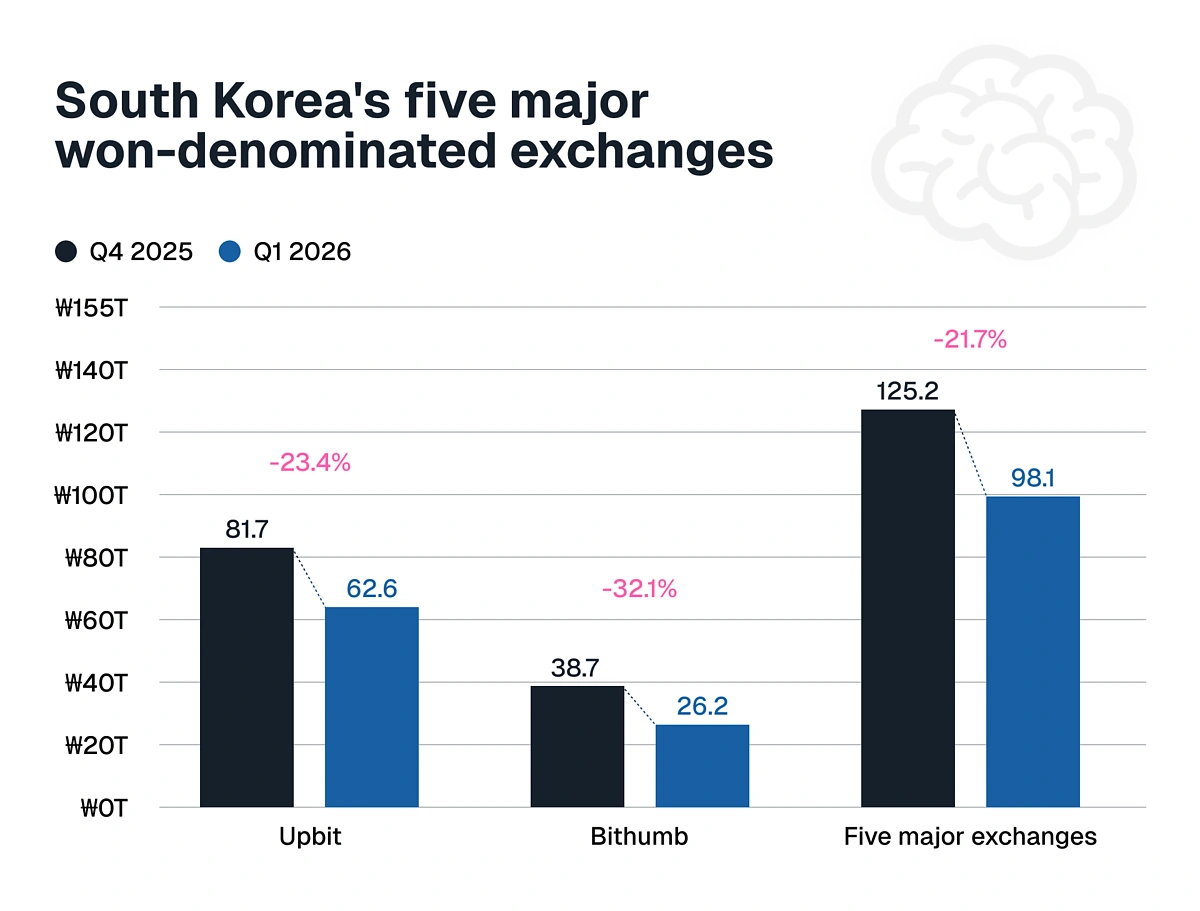
Volume is down, but it's not a retreat. Average monthly KRW-denominated exchange volume dropped 21.7% from Q4 2025 to Q1 2026. Capital isn't leaving, it's shifting, moving from retail speculation into institutional settlement layers.
-
Stablecoins are picking up the slack. The Stablecoin Market Cap to KRW Exchange Volume ratio jumped from 2.8x to 3.6x in the same window. That's a clear signal: stablecoins aren't just being traded anymore, they're being used as deployable liquidity.
-
KRWQ has real institutional traction, but there's still no domestic legal framework for it. South Korea's first multichain KRW stablecoin hit 1 billion won in daily volume by April 2026, mostly driven by offshore hedge funds. Regulators haven't caught up yet.
-
The Bithumb incident pushed regulation forward. A February 2026 operational error sent out 2,000 actual Bitcoins instead of 2,000 won per user. That triggered a new mandatory five-minute ledger reconciliation rule across all domestic exchanges.
-
Institutional entry is now official policy. Spot Bitcoin ETF approval is on a fast track, and the nine-year ban on corporate crypto investment was lifted in January 2026, capped at 5% of shareholder equity per year.
The Digital Ice Age: What the Volume Drop Actually Means
South Korea's five major won-denominated exchanges, Upbit, Bithumb, Coinone, Korbit, and Gopax, saw average monthly volume fall from 125.2 trillion won in Q4 2025 to 98.1 trillion won in Q1 2026. Upbit dropped 23.4%. Bithumb fell 32.1%.
Three things drove that.
First, the investor base has matured. Bitcoin held steady between $60,000 and $72,000, but domestic trading stayed flat anyway. Speculative capital has washed out. On-chain transaction frequency hit multi-year lows while active wallet counts held, meaning people are holding, not leaving.
Second, traditional equities pulled liquidity away. Samsung Electronics and SK Hynix posted record profits on AI-driven semiconductor demand. The KOSPI climbed. New 2x leveraged semiconductor ETFs absorbed exactly the kind of risk appetite that used to flow into altcoins.
Third, the macro environment was tough. The Middle East conflict pushed oil prices up 50% in early 2026. The Bank of Korea kept rates at 2.50% all year to fight inflation. Not a great backdrop for risk assets. A ceasefire in April 2026 eased some of that pressure, but energy costs are still elevated.
The takeaway: The decline in exchange volumes should be read not as a withdrawal of market interest, but as a maturation of how that interest is expressed.
The Exchange Landscape: Concentration and New Owners
Upbit and Bithumb still control around 96% of all trading volume. That hasn't changed. What has changed is who owns the infrastructure underneath.
 The FSC and the ruling Democratic Party have proposed ownership caps of 20% for major shareholders in domestic exchanges, expected to be codified in DABA Phase 2. Large exchanges get a three-year compliance window, while smaller platforms get six.
The Bithumb Incident and the Five-Minute Rule
On February 6, 2026, Bithumb accidentally distributed 2,000 actual Bitcoins to users during a promotion that was supposed to give 2,000 won each, roughly $1.38. The total erroneous allocation reached approximately 620,000 BTC, which is way more than Bithumb actually holds (around 42,800 BTC). They recovered 99.7% of it, but not before triggering a 17% flash crash in the BTC/KRW pair.
Regulators moved fast. The FSS and FSC required all domestic exchanges to implement automated ledger-to-wallet reconciliation every five minutes, replacing the old 24-hour standard. They also mandated monthly external audits, automated transaction halts for ledger discrepancies, and multi-level approval for high-risk operations.
The market impact was significant. Bithumb's share dropped from 31.5% in early January to 24.8% by late February. Meanwhile, Coinone essentially doubled its footprint to 13% as investors looked for stability. Korbit gained ground too, helped by the credibility that came with Mirae Asset's acquisition.
The Stablecoin Debate: DABA Phase 2
South Korea is in the middle of Phase 2 of the Digital Asset Basic Act. The core fight is over who gets to issue a won-pegged stablecoin.
The Bank of Korea wants a stability-first approach: stablecoins issued by banking consortia where traditional banks hold majority control. The FSC disagrees, arguing any entity that meets strict capital and technical requirements should be eligible.
While that debate drags on in the National Assembly, the market isn't waiting. KRWQ, co-developed by IQ and Frax and launched on Base in October 2025, hit 1 billion won in daily volume by April 2026. It's being driven primarily by foreign institutional hedging. Overseas hedge funds and asset managers are using KRWQ to hedge KRW appreciation on KOSPI and KOSDAQ positions, and it's cheaper and operationally simpler than traditional non-deliverable forwards.
The ongoing gridlock means offshore entities are filling a vacuum that domestic firms can't legally occupy. South Korea risks hosting the primary liquidity for its own currency on foreign, decentralized networks.
GIWA: South Korea's Sovereignty Play
Dunamu's GIWA (Global Infrastructure for Web3 Access), unveiled at the Upbit D Conference in 2025, is South Korea's answer to that offshore liquidity problem. It's an Ethereum Layer 2 built on the Optimism Foundation's OP Stack, with one-second block times and full EVM compatibility. Those aren't just technical specs; they're prerequisites for institutional settlement use cases like equity hedging and derivative clearing.
For KYC/AML, GIWA uses two tools: Dojang, which issues on-chain identity attestations tied to off-chain verification, and GIWA Wallet, which supports multi-chain access across Ethereum, Arbitrum, Base, Polygon, and Avalanche. Dojang’s attestations are represented as GIWA ID, a non-transferable Soul-Bound Token functioning as a digital passport.
Think of it this way: KRWQ is offshore liquidity capture. GIWA is the attempt to bring that liquidity back home. Whether the legislative environment resolves in time to let it succeed is the open question.
Institutional Entry: ETFs and Corporate Trading
The FSC is fast-tracking changes to the Capital Markets Act to recognize digital assets as eligible ETF underlying assets. They're also building a composite price index across the five major domestic exchanges to solve the absence of a unified KRW price, which is a prerequisite for ETF market-making.
On corporate access, the FSC finalized guidelines in January 2026 lifting the nine-year ban on corporate crypto investment. Listed companies and professional investors can now put up to 5% of shareholder equity into digital assets annually. As corporations start holding digital assets on their balance sheets, on-chain settlement infrastructure like KRWQ stops being speculative and becomes operational.
The Political Economy: Taxes, Surveillance, and the June Elections
About 16 million voters, roughly one-third of South Korean adults, are active in digital asset markets. That's made crypto policy a central issue in the June 3, 2026 local elections. The hottest topic is a 22% tax on cryptocurrency trading profits, set to kick in January 1, 2027.
The opposition People Power Party wants to scrap it, arguing it puts crypto at a disadvantage relative to equities and pushes activity offshore. Adding to the tension, the National Tax Service deployed a 3 billion won AI surveillance platform to monitor transaction patterns across domestic and international exchanges in real time. The irony is that this may actually be accelerating the capital flight it's trying to prevent, pushing high-volume participants toward on-chain stablecoin settlement layers that are harder to monitor.
The Bitcoin Kimchi Premium, the persistent price gap between Korean exchanges and global averages, hit a 10-month high of 9.7% in early April 2026. Capital controls keep arbitrage from closing it, and research suggests a structural floor of around 1.24% will stick as long as those controls remain.
Conclusion
South Korea's digital asset market hasn't retreated. It's matured. The drop in exchange volumes reflects a consolidation of speculative capital, not a loss of interest. Underneath that, institutional-grade infrastructure is being built quickly. GIWA provides the domestic settlement layer. KRWQ shows offshore demand is real. ETF approval and corporate participation rules round out the structural picture.
The key variable is legislative timing. The standoff between the BOK and FSC over stablecoin eligibility has to resolve before institutional participation can move from offshore pilots to regulated domestic operations. With June elections approaching, political will is there. Whether legislation follows before the offshore ecosystem becomes too entrenched to displace, that's the defining question for South Korea's digital financial future.
This article is only for informational purposes and should not be taken as financial or investment advice.


 Or check it out in the app stores


 Arbitrum
 Avalanche
 Fantom
 Flare
Flare
 Gnosis
 Linea
Linea
 Optimism
 Polygon
 Polygon zkEVM
 Scroll
 Stellar
 Story
Story
 Syscoin
 Telos
Telos
 X Layer
 Xai
Xai


